
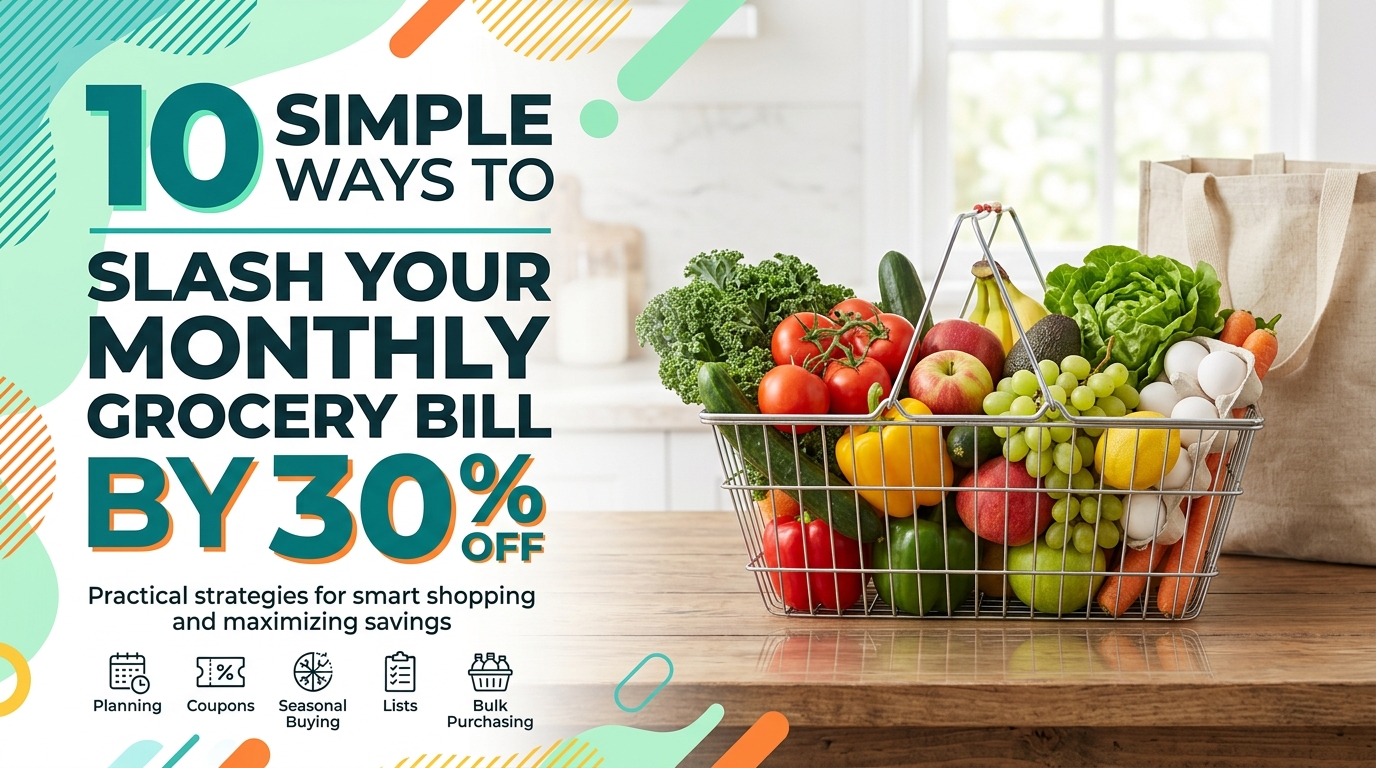
Hey there, ever stared at your grocery receipt, heart sinking as it hits $200 for what feels like a week’s worth of ramen and regret? You’re not alone. In tier-one spots like the US, UK, or Canada, the average family shells out about $475 a month on groceries (that’s BLS data from 2025), and with inflation still nipping at heels, it’s easy to feel the pinch. But here’s the good news: you can slash your monthly grocery bill by 30%—that’s up to $140 back in your pocket—without eating like a squirrel or hunting for expired coupons in the parking lot.
I’ve been that frugal experimenter myself. A few years back, after a surprise car repair wiped my buffer, I turned grocery shopping into a game. Tweaked a few habits, and boom—my bill dropped from $450 to $315 monthly. No fancy apps required, just smart, simple swaps. In this guide, we’ll dive into 10 proven ways to cut grocery costs, backed by real stats and easy steps. Stick with me, and you’ll be toasting with cheaper wine (or sparkling water) in no time.
Contents
- 1 Why Slashing Your Grocery Bill Matters Now More Than Ever
- 2 1. Master the Art of Meal Planning (Your Weekly Game-Changer)
- 3 2. Shop the Perimeter and Ditch Impulse Aisles
- 4 3. Embrace the Power of Store Brands and Generics
- 5 4. Time Your Trips Like a Pro: Off-Peak and Clearance Hunting
- 6 5. Buy in Bulk—But Only What You Use
- 7 6. Go Seasonal and Local for Peak Freshness, Lowest Prices
- 8 7. Cook from Scratch and Batch It Up
- 9 8. Use Cash, Set a Budget, and Track Every Penny
- 10 9. Minimize Protein Swaps: Stretch Meat with Plants
- 11 10. Waste Not: Inventory, Portion, and Repurpose Leftovers
- 12 Grocery Savings Tracker Table
- 13 Putting It All Together: Your 30% Savings Roadmap
Why Slashing Your Grocery Bill Matters Now More Than Ever
Before we jump into the tips, a quick reality check: Food prices rose 2.5% last year alone (USDA 2025 report), hitting staples like meat and dairy hardest. But households that actively track and tweak spending save 25-35% on average, per Nielsen consumer insights. These aren’t gimmicks—they’re sustainable habits that fit busy lives in high-cost cities like New York or Toronto. Ready to reduce food expenses? Let’s roll.
1. Master the Art of Meal Planning (Your Weekly Game-Changer)
Ever bought ingredients for three recipes, only to use one and let the rest rot? Guilty as charged—that’s $50 down the drain monthly for many folks.
How to slash your monthly grocery bill by 30% here: Spend 20 minutes Sunday planning 5-7 dinners around what you already have. Use free tools like a simple Google Sheet or apps like Mealime.
-
Inventory your pantry first: List proteins, veggies, and staples.
-
Theme your week: Meatless Monday, Taco Tuesday—build from sales flyers.
-
Example: Last week, I planned chicken stir-fry (using leftover rice), lentil soup (pantry beans), and pasta primavera (on-sale veggies). Total cost? $25 for three meals feeding four.
Pro tip: Aim for “one protein, three meals” (e.g., roast chicken becomes salads and tacos). Studies show meal planners waste 30% less food, directly cutting costs.
2. Shop the Perimeter and Ditch Impulse Aisles
Supermarkets are sneaky geniuses—eye-level junk food screams “buy me!” while basics hide.
Quick win to cut grocery costs: Stick to the store’s outer edges: produce, dairy, meats, bakery. Venture inside only for specifics on your list.
-
Skip end-caps (80% marked up, per Consumer Reports).
-
Personal anecdote: I once grabbed “bargain” chips on impulse—$4 wasted. Now, I treat the middle aisles like a casino: enter with a plan, leave with savings.
Result? Shoppers who perimeter-shop save 20-25% instantly.
3. Embrace the Power of Store Brands and Generics
Name brands charge for fancy ads—you’re paying for the logo.
Way to reduce food expenses: Swap 70% of your cart to store brands. They’re often made in the same factories (blind taste tests prove it).
Here’s a quick comparison table:
(Total for these: $13.77 name vs. $7.57 store—save $75/year per category.)
Humor alert: My kids couldn’t tell the difference in mac ‘n’ cheese. “Mom, did you upgrade?” Nope, just smarter shopping.
4. Time Your Trips Like a Pro: Off-Peak and Clearance Hunting
Grocery stores jack prices on weekends; markdowns hide mid-week.
Pro move: Shop Tuesdays/Wednesdays after 5 PM for 30-50% off expiring stock (varies by chain like Kroger or Tesco).
-
Check apps like Flipp for weekly ads.
-
Anecdote: I scored $20 in marked-down produce (perfectly ripe avocados for guac) on a quiet Wednesday—felt like winning the lottery.
This alone can slash your monthly grocery bill by 10-15%.
5. Buy in Bulk—But Only What You Use
Warehouse clubs like Costco tempt with giants, but waste kills savings.
Smart bulk buying to slash your monthly grocery bill by 30%:
-
Focus on non-perishables: rice, oats, canned tomatoes (unit price drops 20-40%).
-
Split with a friend for big meats.
-
Freeze extras: Portion ground beef into bags for future tacos.
Warning: Skip bulk greens—they spoil fast. My freezer’s a hero; one bulk chicken buy fed us for weeks.
6. Go Seasonal and Local for Peak Freshness, Lowest Prices
Out-of-season strawberries in winter? Highway robbery at $6/pint.
Seasonal hack: Shop farmers’ markets or store sections for in-season produce—prices plummet 30-50%.
-
Summer: Berries, zucchini, corn.
-
Winter: Root veggies, citrus, kale.
-
Example: Swap imported tomatoes ($3/lb) for local summer ones ($1.50/lb).
Cultural nod: Like how Italians swear by what’s growing now—fresher, cheaper, tastier.
7. Cook from Scratch and Batch It Up
Pre-made meals are convenience taxes—frozen lasagna costs 3x homemade.
Batch-cooking to cut grocery costs: Prep staples Sundays: sauces, chili, veggie stock. Use for multiple meals.
-
Recipe idea: Big pot of veggie chili ($15 for 8 servings = $1.88 each).
-
Saves time and money: Home cooks spend 25% less, per USDA.
I batch soups weekly—freezer pulls save my rushed evenings.
8. Use Cash, Set a Budget, and Track Every Penny
Credit cards hide the pain; cash makes you wince at extras.
Budget tip: Allocate $75-100/week cash. Use a tracker app like Mint or a notebook.
-
Pre-shop visualization: “Can I live on $90?”
-
Track wins: My first month, spotting $30 in “snack creep” was eye-opening.
Apps show patterns—cut soda, save $20/month easy.
9. Minimize Protein Swaps: Stretch Meat with Plants
Meat’s the budget buster (40% of bills, rising fastest).
Protein pivot: Stretch with beans/lentils (1/4 cost of beef). Aim for 2-3 meatless dinners weekly.
-
Example: Beef stir-fry becomes tofu version—save $8/meal.
-
Health bonus: More fiber, per Harvard studies.
Vegetarian twist on shepherd’s pie? My family’s new fave, wallet-approved.
10. Waste Not: Inventory, Portion, and Repurpose Leftovers
The average family tosses $1,500 in food yearly (NRDC stats)—that’s 30% of spending!
Zero-waste strategy:
-
Daily fridge check: “Eat me first” zones.
-
Repurpose: Leftover rice into fried rice; veggies into frittatas.
-
Compost or donate extras.
Anecdote: Turned “sad” carrots into soup—zero waste, full bellies. Tools like the free “SuperCook” app invent meals from leftovers.
Grocery Savings Tracker Table
Track your progress with this simple table (print or app-ify it):
Putting It All Together: Your 30% Savings Roadmap
Stack these 10 ways, and slashing your monthly grocery bill by 30% is realistic—many readers report hitting it in 4-6 weeks. Start with meal planning and store brands for quick wins, then layer in bulk and seasonal buys. Track for a month; adjust what sticks.
Imagine that extra $140 funding date nights, debt payoff, or that emergency fund boost. You’ve got this—your future self (and wallet) will high-five you.