
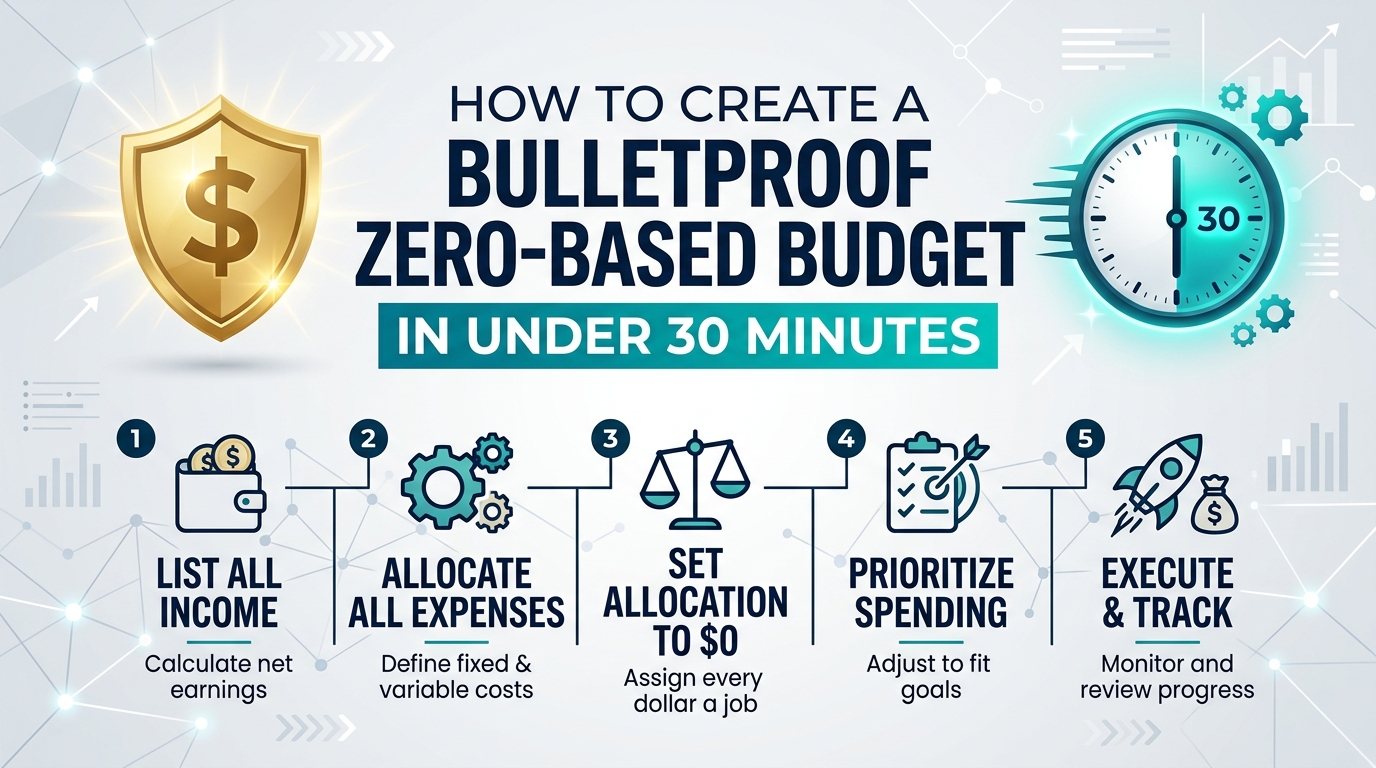
Picture this: Payday hits, and poof—your paycheck vanishes into a black hole of coffee runs, subscriptions you forgot, and “essentials” that aren’t. Sound familiar? In high-cost spots like the US, UK, or Australia, the average household income hovers around $75,000 yearly (BLS 2025), but 60% live paycheck-to-paycheck (LendingClub report). Frustrating, right?
Enter zero-based budgeting: Every dollar gets a job, so nothing’s left wandering. It’s not deprivation—it’s control. I’ve used it to claw back $500/month after a layoff scare, turning chaos into calm. Best part? You can create a bulletproof zero-based budget in under 30 minutes with this guide. We’ll break it down step-by-step, no spreadsheets required (though I’ll suggest free ones). Grab a coffee, set a timer, and let’s build your personal budget plan that actually sticks.
Contents
- 1 What Makes Zero-Based Budgeting Bulletproof?
- 2 Step 1: Gather Your Numbers (5 Minutes Flat)
- 3 Step 2: List All Expenses—Be Brutally Honest (5 Minutes)
- 4 Step 3: Assign Every Dollar a Job (10 Minutes Core Build)
- 5 Step 4: Prioritize and Slash the Fat (5 Minutes)
- 6 Step 5: Track Weekly and Adjust (5 Minutes Weekly Habit)
- 7 Sample Monthly Budget Graph Idea
- 8 Common Pitfalls and How to Bulletproof Your Budget
- 9 Advanced Twists for Long-Term Wins
- 10 Wrap-Up: Your 30-Minute Budget, Lifetime Freedom
What Makes Zero-Based Budgeting Bulletproof?
Traditional budgets guess; zero-based ones assign every dollar to a category until you hit zero. Inspired by Dave Ramsey and YNAB (You Need A Budget), it forces intentionality. Research shows users cut spending by 20-30% in the first month (YNAB 2025 study). Perfect for busy folks in tier-one cities juggling rent, commutes, and that sneaky Uber Eats habit.
Ready? We’ll time it: 5 mins prep, 20 mins building, 5 mins tweaking. Tools: Pen/paper, phone calculator, or free Google Sheets template (link below).
Step 1: Gather Your Numbers (5 Minutes Flat)
No fluff—log your basics.
Quick audit:
-
Income: Tally take-home pay (after taxes). Example: $4,500/month net.
-
Fixed bills: Rent/mortgage ($1,800), utilities ($250), insurance ($150), minimum debt payments ($300). Total: $2,500.
-
Bank balance check: Peek at accounts for irregulars like quarterly fees.
Personal story: My first time, I forgot a $20 gym autopay—lesson learned. Use your bank’s app for speed.
Pro Tip: Annualize bonuses (e.g., $2,000 year-end /12 = $167/month).
Step 2: List All Expenses—Be Brutally Honest (5 Minutes)
Brain-dump every spend. Categorize ruthlessly.
Essential categories for your zero-based budget:
-
Housing (rent, maintenance)
-
Food (groceries, dining out—cap at 15% income)
-
Transport (gas, transit, car payment)
-
Utilities/Subscriptions (Netflix? Audit!)
-
Debt/Loans
-
Savings/Investments (aim 10-20%)
-
Fun/Giving (yes, include guilt-free fun)
-
Irregulars (gifts, repairs—fund monthly)
Example from my budget: Dining out was $400—yikes! Capped at $150.
Humor break: That “misc” category? It’s where money goes to die. Banish it.
Step 3: Assign Every Dollar a Job (10 Minutes Core Build)
Subtract fixed from income, then divvy the rest. Income – Expenses = Zero.
The magic formula: Start with income at top. Assign down until balance hits zero.
Here’s a starter Zero-Based Budgeting Template Table (copy to Sheets; takes 2 mins):
Filling it out:
-
Fixed first: Plug in bills.
-
Essentials: Food 10-15% ($450-675), transport 10%.
-
Cushion: 5-10% buffer ($225-450) for surprises—rollover to savings.
-
Fun last: What’s left? Party!
Anecdote: I “gave” $100 to “coffee fund”—capped my lattes, saved $75 real.
Step 4: Prioritize and Slash the Fat (5 Minutes)
Over budget? Trim non-essentials.
Quick cuts to make it bulletproof:
-
Dining: Halve it (home-cooked tacos > takeout).
-
Subs: Cancel two ($20/month each).
-
Impulse: Rule—sleep on non-grocery buys over $20.
Expert nod: Ramsey says “rice and beans, beans and rice” phase if needed, but aim sustainable.
Sinking Funds for Irregulars: Monthly mini-saves, e.g., $50/car repair, $30/birthdays. Prevents debt spirals.
Step 5: Track Weekly and Adjust (5 Minutes Weekly Habit)
It’s not set-it-forget-it. Review Sundays.
Tracking hacks:
-
Apps: YNAB (paid, powerful), Goodbudget (free envelopes), or PocketGuard.
-
Manual: Photo receipts, log in table.
-
Weekly check-in: Under in groceries? Boost savings.
My twist: “Fun jar”—visual cash for entertainment. Hits zero? No more spending.
Sample Monthly Budget Graph Idea
(Visualize in Sheets: Bar chart of Budgeted vs. Actual across categories. Green for under, red for over—motivates like a fitness tracker.)
Common Pitfalls and How to Bulletproof Your Budget
-
Underestimating: Add 10% buffer. Real life: Vet bill nuked my first budget.
-
Forgetting Income Fluctuations: Gig workers—average 3 months.
-
Partner Buy-In: Share screen-share session; make it date night.
-
Inflation Hack: Review quarterly; 2025 CPI up 2.4% on food/energy.
Cultural ref: Like the Japanese “kakeibo” journaling—mindful spending builds wealth.
Advanced Twists for Long-Term Wins
Once comfy, level up:
-
Debt Snowball: Extra to smallest debt first.
-
50/30/20 Rule Integration: 50% needs, 30% wants, 20% savings—fits zero-based perfectly.
-
Automation: Auto-transfer savings Day 1.
Stats boost: Zero-based users build $4,000 emergency funds 2x faster (YNAB data).
Wrap-Up: Your 30-Minute Budget, Lifetime Freedom
Boom—you just learned how to create a bulletproof zero-based budget in under 30 minutes. Recap: Gather numbers, list expenses, assign dollars, prioritize, track. It’s simple, powerful, and turns “where’d my money go?” into “I’ve got this.”
Start tonight: Pause, build yours using the table. In a month, you’ll see real traction—more savings, less stress.
Your move: Timer ready? Share your first budget win in the comments—what’s your biggest “aha” category? Tag a friend who’s always “broke”—help them create a bulletproof zero-based budget in under 30 minutes too!