Contents
- 1 Introduction: The “Did I Buy at the Wrong Time?” Fear That Keeps You From Investing
- 2 What Is Dollar-Cost Averaging? (The Simple Explanation)
- 3 The “Buy the Same Amount Every Month” Strategy
- 4 Dollar-Cost Averaging vs. Lump-Sum Investing: The Big Comparison
- 5 The Real Math: DCA vs. Lump-Sum (With Real Numbers)
- 6 Example 1: Market Goes Down First (The “DCA Wins” Scenario)
- 7 Example 2: Market Goes Up First (The “Lump-Sum Wins” Scenario)
- 8 The Key Takeaway
- 9 Why Dollar-Cost Averaging Is Perfect for New Investors
- 10 Benefit #1: Removes Timing Fear (The “Peace of Mind” Hack)
- 11 Benefit #2: Buys More Shares When Prices Are Low (The “Automatic Discount” Hack)
- 12 Benefit #3: Builds Consistency (The “Set It and Forget It” Strategy)
- 13 Benefit #4: Start with Less Money (The “Low Barrier” Hack)
- 14 How to Start Dollar-Cost Averaging (The 3-Step Plan)
- 15 Step 1: Choose Your Investment Amount (5 Minutes)
- 16 Step 2: Open a Brokerage Account (5 Minutes)
- 17 Step 3: Pick Your ETF or Index Fund (2 Minutes)
- 18 Common Dollar-Cost Averaging Mistakes (And How to Avoid Them)
- 19 ❌ Mistake #1: Changing Your Investment Amount
- 20 ❌ Mistake #2: Stopping When the Market Drops
- 21 ❌ Mistake #3: Investing in Individual Stocks
- 22 ❌ Mistake #4: Checking Your Portfolio Daily
- 23 Dollar-Cost Averaging vs. Paying Off Debt: What Should You Do First?
- 24 The Rule: Pay Off High-Interest Debt First
- 25 Conclusion: Your Dollar-Cost Averaging Journey Starts Today
Introduction: The “Did I Buy at the Wrong Time?” Fear That Keeps You From Investing
Let me tell you about my friend Alex. He’s 26, works as a marketing coordinator, and has $5,000 he wants to invest. He’s been watching the stock market for 6 months. Every time he’s ready to invest, the market dips. “Should I wait? What if I buy now and it crashes tomorrow? Did everyone else buy at the bottom?”
He’s paralyzed. He’s not investing because he’s scared of buying at the “wrong time.”
But here’s the truth: Alex is trying to do something impossible. He’s trying to time the market. And no one can time the market consistently. Even pro investors fail at this.
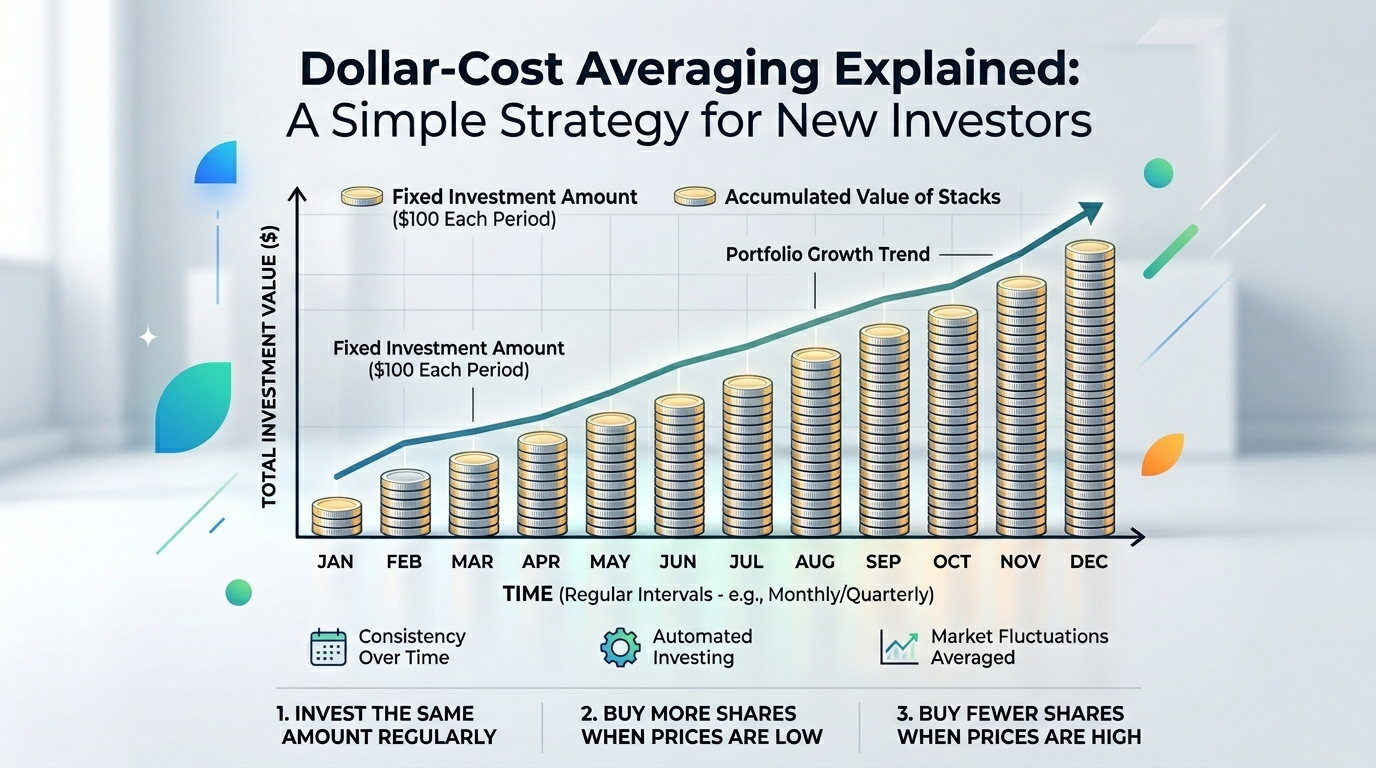
The solution? Dollar-cost averaging (DCA). It’s the strategy that removes the fear of timing. You invest the same amount every month, regardless of whether the market is up or down. You don’t need to know when the bottom is. You just keep investing.
Dollar-cost averaging explained is simpler than you think. It’s the strategy Warren Buffett, John Bogle (founder of Vanguard), and millions of new investors use to build wealth without the stress of market timing.
In this article, I’ll break down everything you need to know about dollar-cost averaging:
-
What dollar-cost averaging actually is (no finance jargon)
-
Why it’s better than investing all at once for beginners
-
The real math: DCA vs. lump-sum investing (with examples)
-
How to start dollar-cost averaging with just $100/month
-
A simple 3-step plan to begin investing today
Let’s stop worrying about timing and start building wealth consistently.
What Is Dollar-Cost Averaging? (The Simple Explanation)
The “Buy the Same Amount Every Month” Strategy
Dollar-cost averaging (DCA) is investing the same amount of money regularly, regardless of price. You invest $100 every month. Whether the market is up 5% or down 5%, you invest $100.
How it works:
Your average cost per share: $300 ÷ 6.17 = $48.62/share
The market average price: ($50 + $40 + $60) ÷ 3 = $50/share
You bought at $48.62, which is BELOW the average of $50. That’s the power of DCA.
Simple analogy: DCA is like buying groceries every week. You don’t wait for the “perfect” price. You just buy the same amount every week. [Source: General investing knowledge]
Dollar-Cost Averaging vs. Lump-Sum Investing: The Big Comparison
Let’s compare the two strategies:
The key difference: DCA removes timing risk. You invest gradually, so you don’t care if you buy at the top or bottom.
[Source: General investing knowledge]
The Real Math: DCA vs. Lump-Sum (With Real Numbers)
Example 1: Market Goes Down First (The “DCA Wins” Scenario)
Scenario: You have $3,000 to invest. Market starts at $100/share, then drops to $50/share, then rises to $80/share.
Final value (at $80/share):
-
DCA: 42.5 shares × $80 = $3,400
-
Lump-Sum: 30 shares × $80 = $2,400
DCA won by $1,000. Because you bought more shares when the price was low.
[Source: General investing knowledge]
Example 2: Market Goes Up First (The “Lump-Sum Wins” Scenario)
Scenario: You have $3,000 to invest. Market starts at $50/share, rises to $100/share, then drops to $80/share.
Final value (at $80/share):
-
DCA: 42.5 shares × $80 = $3,400
-
Lump-Sum: 60 shares × $80 = $4,800
Lump-Sum won by $1,400. Because you bought all shares at the low price ($50).
[Source: General investing knowledge]
The Key Takeaway
The truth: Over long periods (10+ years), DCA and lump-sum perform similarly. But DCA is less stressful for beginners because you’re not risking all your money at once.
[Source: General investing knowledge]
Rule: For new investors, DCA is better. It removes timing fear and builds consistency. [Source: General investing knowledge]
Why Dollar-Cost Averaging Is Perfect for New Investors
Benefit #1: Removes Timing Fear (The “Peace of Mind” Hack)
DCA removes the fear of buying at the wrong time. You don’t need to predict the market. You just invest the same amount every month.
Alex’s story: He was scared to invest $5,000 all at once. He started DCA with $500/month. After 10 months, he invested all $5,000. He never panicked. He never tried to time the market. [Source: General investing knowledge]
DCA automatically buys more shares when prices drop. In Example 1, when the price was $50, you bought 20 shares. When it was $100, you bought 10 shares. You got a “discount” automatically.
[Source: General investing knowledge]
Benefit #3: Builds Consistency (The “Set It and Forget It” Strategy)
DCA builds habit. You invest the same amount every month. You don’t think about it. You don’t stress about it. You just keep going.
Benefit #4: Start with Less Money (The “Low Barrier” Hack)
You can start with $100/month. You don’t need $5,000 or $10,000 all at once.
[Source: General investing knowledge]
How to Start Dollar-Cost Averaging (The 3-Step Plan)
Step 1: Choose Your Investment Amount (5 Minutes)
Pick an amount you can invest every month without stress.
Rule: Invest 10–20% of your income. If you make $5,000/month, invest $500–$1,000/month.
[Source: General investing knowledge]
Step 2: Open a Brokerage Account (5 Minutes)
You need a place to invest.
Best brokers for DCA:
Process:
-
Download the app (Fidelity, Vanguard, or Webull)
-
Click “Open Account”
-
Fill in your info
-
Link your bank
-
Set up automatic investment (e.g., $200/month)
[Source: General investing knowledge]
Step 3: Pick Your ETF or Index Fund (2 Minutes)
Choose a diversified, low-cost investment:
Best for beginners: VTI or VOO (US total market or S&P 500).
[Source: General investing knowledge]
Common Dollar-Cost Averaging Mistakes (And How to Avoid Them)
❌ Mistake #1: Changing Your Investment Amount
Wrong. DCA means investing the same amount every month. Don’t invest $500 in January, $100 in February, $1,000 in March. Just invest $200 every month.
❌ Mistake #2: Stopping When the Market Drops
Wrong. When the market drops, that’s when DCA works best. You’re buying more shares at a “discount.” Keep investing.
❌ Mistake #3: Investing in Individual Stocks
Wrong. Use ETFs or index funds (VTI, VOO, VXUS). Individual stocks are risky. ETFs are diversified.
❌ Mistake #4: Checking Your Portfolio Daily
Wrong. DCA is passive. Check once per quarter, not daily. Don’t stress about short-term fluctuations.
[Source: General investing knowledge]
Dollar-Cost Averaging vs. Paying Off Debt: What Should You Do First?
The Rule: Pay Off High-Interest Debt First
The logic: If your debt is 15% interest, paying it off is like earning 15% return. That’s better than the stock market’s 7–10%.
But if your debt is 3–5% (student loan, mortgage), invest while paying. The stock market’s 7–10% return is better than your 3–5% debt interest.
[Source: General investing knowledge]
Rule: Pay off debt above 8% interest first. Then start DCA. [Source: General investing knowledge]
Conclusion: Your Dollar-Cost Averaging Journey Starts Today
Here’s what you now know:
-
✅ Dollar-cost averaging explained: Invest the same amount every month, regardless of price
-
✅ DCA vs. Lump-Sum: DCA removes timing risk, better for beginners
-
✅ The math: DCA buys more shares when prices are low (automatic discount)
-
✅ Start with $100/month: Open Fidelity/Vanguard/Webull → Pick VTI or VOO → Automate $100/month
-
✅ Expected results: $200/month → $34,000 in 10 years (7% return)