Contents
- 1 Introduction: The “I Don’t Know How to Invest” Panic That Hits Every Sunday Night
- 2 What Is an ETF? (The Simple Explanation)
- 3 The “Basket of Everything” Analogy
- 4 Real Examples of ETFs
- 5 Why ETFs Are Perfect for Beginners (The 5 Big Benefits)
- 6 Benefit #1: Instant Diversification (The “Don’t Lose Everything” Safety)
- 7 Benefit #2: Ultra-Low Cost (The “Save $1,000s” Hack)
- 8 Benefit #3: Passive Investing (The “Set It and Forget It” Strategy)
- 9 Benefit #4: Trade Like Stocks (The “Flexible” Benefit)
- 10 Benefit #5: Start with $100 (The “Low Barrier” Hack)
- 11 ETFs vs. Index Funds vs. Individual Stocks: The Big Comparison
- 12 The 5 Best ETFs for 2026 (Start Your Portfolio Today)
- 13 ETF #1: Vanguard S&P 500 ETF (VOO) — The “Core” ETF
- 14 ETF #2: Vanguard Total Stock Market ETF (VTI) — The “Everything US” ETF
- 15 ETF #3: Vanguard Total International Stock ETF (VXUS) — The “Global” ETF
- 16 ETF #4: iShares Aggregate Bond ETF (BND) — The “Stability” ETF
- 17 ETF #5: Vanguard REIT ETF (VNQ) — The “Real Estate” ETF
- 18 Visual: The “Core Trio” ETF Portfolio (The Simple 3-ETF Strategy)
- 19 How to Build a Low-Cost Portfolio with $100 (The 3-Step Plan)
- 20 Step 1: Open a Brokerage Account (5 Minutes)
- 21 Step 2: Buy Your First ETFs (2 Minutes)
- 22 Step 3: Set Up Automatic Monthly Contributions (1 Minute)
- 23 Common ETF Mistakes (And How to Avoid Them)
- 24 ❌ Mistake #1: Buying High-Cost ETFs
- 25 ❌ Mistake #2: Checking Prices Daily
- 26 ❌ Mistake #3: Not Rebalancing
- 27 ❌ Mistake #4: Buying Too Many ETFs
- 28 Conclusion: Your First ETF Portfolio Is Waiting for You
Introduction: The “I Don’t Know How to Invest” Panic That Hits Every Sunday Night
Let me tell you about my friend Lisa. She’s 29, works as a graphic designer, and every Sunday night she gets this panic. “I have $3,000 in my savings account. Inflation is 3%. My money is losing value. I should invest, but I don’t know which stocks to buy. What if I pick the wrong one? What if I lose everything?”
She’s been stuck for 2 years. She downloaded Robinhood, looked at the stock market, and closed it. She watched YouTube videos about investing, but they all talked about “technical analysis” and “P/E ratios.” She’s confused.
But here’s the good news: Lisa started investing in ETFs with $100 last month. She now has a diversified portfolio of 500+ companies. She’s not stressed. She’s not picking stocks. And she’s earning 7–10% annually without doing anything.
If you’re feeling that Sunday night panic, you’re not alone. Millions of people in the US, UK, Canada, and Australia want to invest but don’t know how. They think they need to be a finance expert. They’re wrong.
The beginner’s guide to ETFs is simpler than you think. ETFs are the easiest way to build a low-cost portfolio that diversified, passive, and grows with the market. Warren Buffett, John Bogle (founder of Vanguard), and millions of everyday investors use ETFs to build wealth without the stress.
In this article, I’ll show you everything you need to know about ETFs for beginners:
-
What an ETF actually is (no finance jargon)
-
Why ETFs are better than individual stocks for beginners
-
The best ETFs for 2026 (with real examples and expense ratios)
-
How to build a low-cost portfolio with just $100
-
A simple 3-step plan to start investing today
Let’s make investing simple again.
What Is an ETF? (The Simple Explanation)
The “Basket of Everything” Analogy
Imagine you want to invest in the stock market, but you’re not sure which company to pick. Apple is great, but what if it crashes? Tesla is hot, but what if it fails?
Instead of picking one company, you buy a basket of hundreds (or thousands) of companies. That basket is an ETF.
An ETF (Exchange-Traded Fund) is a collection of investments that tracks an index, like the S&P 500. When you buy one share of an S&P 500 ETF, you’re instantly owning a tiny piece of all 500 companies in that index.
Simple analogy: Individual stock = betting on one horse. ETF = betting on the entire track.
Real Examples of ETFs
Why ETFs Are Perfect for Beginners (The 5 Big Benefits)
Benefit #1: Instant Diversification (The “Don’t Lose Everything” Safety)
ETFs give you instant diversification. When you buy one ETF share, you own pieces of 500+ companies. If one company crashes, you don’t lose everything.
Example:
Benefit #2: Ultra-Low Cost (The “Save $1,000s” Hack)
ETFs have the lowest fees. The average expense ratio is 0.03–0.10%. That’s 10x cheaper than mutual funds (0.50–1.00%).
The math:
Over 20 years, that’s $1,440 in savings with ETFs.
Rule: Target expense ratio below 0.1% for core ETFs.
Benefit #3: Passive Investing (The “Set It and Forget It” Strategy)
ETFs are passive. They track an index (like S&P 500). You don’t need to research stocks, read financial reports, or watch the market daily.
You just buy and hold. That’s the entire strategy.
Benefit #4: Trade Like Stocks (The “Flexible” Benefit)
ETFs trade like stocks. You can buy/sell them anytime during the day (unlike mutual funds, which settle at end-of-day).
Benefit #5: Start with $100 (The “Low Barrier” Hack)
You can start with $100. Most brokers allow fractional shares. You don’t need $1,000 or $10,000.
ETFs vs. Index Funds vs. Individual Stocks: The Big Comparison
Let’s see which is best for beginners:
Pro tip: For beginners, ETFs are the best choice. Low cost, instant diversification, trade anytime.
The 5 Best ETFs for 2026 (Start Your Portfolio Today)
ETF #1: Vanguard S&P 500 ETF (VOO) — The “Core” ETF
What it tracks: S&P 500 (top 500 US companies)
Companies: Apple, Microsoft, Amazon, Google, Tesla, etc.
Expense ratio: 0.03%
Why it’s great: This is the core ETF. 500 companies, ultra-low cost, 10% annual returns historically.
Best for: 50–70% of your portfolio
ETF #2: Vanguard Total Stock Market ETF (VTI) — The “Everything US” ETF
What it tracks: US Total Market (3,700+ companies)
Companies: All US stocks (large, mid, small-cap)
Expense ratio: 0.03%
Why it’s great: More diversified than VOO. 3,700 companies vs. 500.
Best for: 40–60% of your portfolio
ETF #3: Vanguard Total International Stock ETF (VXUS) — The “Global” ETF
What it tracks: International Stocks (7,500+ companies)
Companies: Apple (US), Toyota (Japan), Samsung ( Korea), Nestlé (Switzerland), etc.
Expense ratio: 0.08%
Why it’s great: Diversifies outside the US. 40% of global market is international.
Best for: 20–30% of your portfolio
What it tracks: US Bonds (10,000+ bonds)
Bonds: Government bonds, corporate bonds, mortgage bonds
Expense ratio: 0.03%
Why it’s great: Bonds are less volatile than stocks. Good for stability.
Best for: 10–30% of your portfolio (depending on age)
ETF #5: Vanguard REIT ETF (VNQ) — The “Real Estate” ETF
What it tracks: Real Estate (150+ properties)
Properties: Apartment buildings, malls, hotels, office spaces
Expense ratio: 0.12%
Why it’s great: Real estate adds diversification. 3–5% annual dividends.
Best for: 5–10% of your portfolio
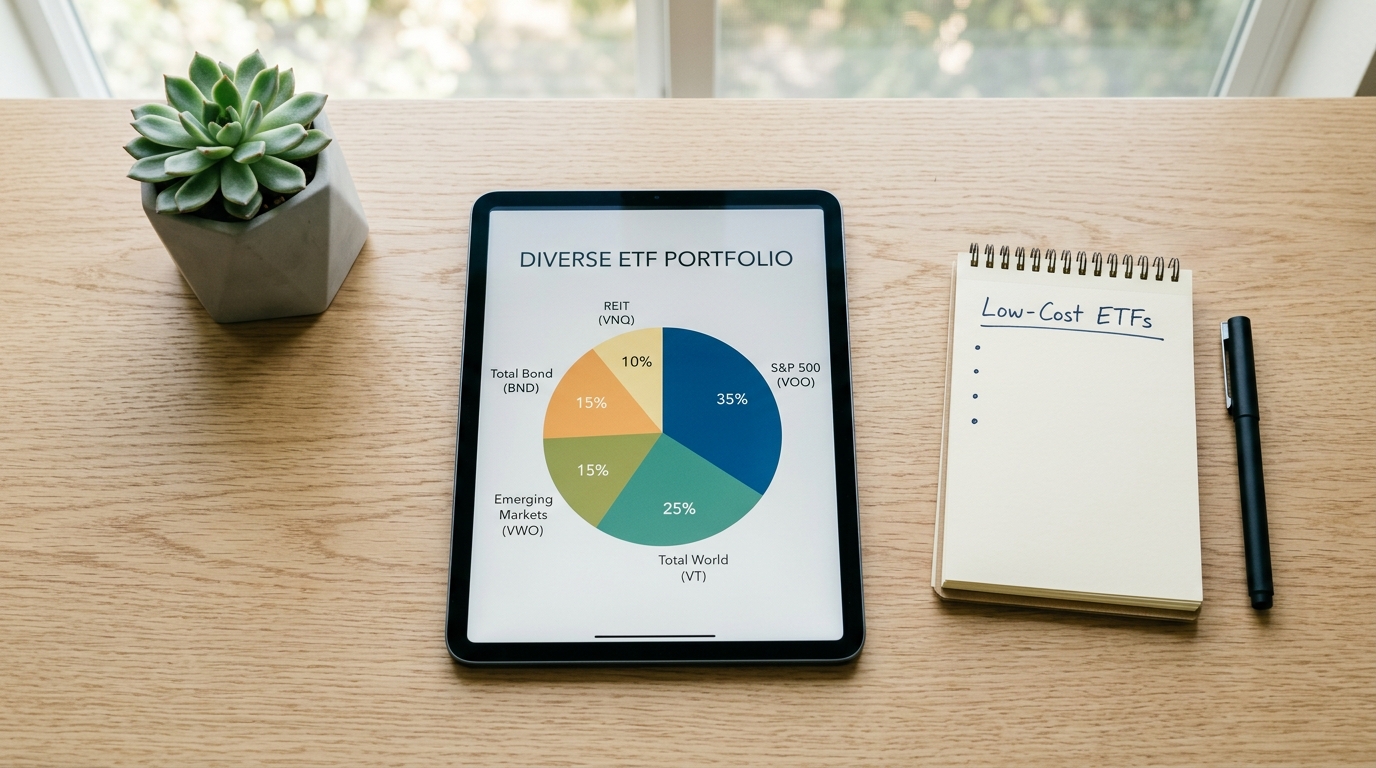
Visual: The “Core Trio” ETF Portfolio (The Simple 3-ETF Strategy)
Here’s the easiest portfolio for beginners:
This is the “Core Trio” strategy from Street Smart Finance:
-
60% VTI (US Total Market)
-
20% VXUS (International)
-
20% BND (Bonds)
Why it works:
-
Instant diversification (11,200+ companies + bonds)
-
Ultra-low cost (0.03–0.08%)
-
7–10% annual returns
-
Passive (set it and forget it)
How to Build a Low-Cost Portfolio with $100 (The 3-Step Plan)
Step 1: Open a Brokerage Account (5 Minutes)
You need a place to buy ETFs.
Best brokers for ETFs:
Process:
-
Download the app (Fidelity, Vanguard, or Webull)
-
Click “Open Account”
-
Fill in your info
-
Link your bank
-
Transfer $100
Step 2: Buy Your First ETFs (2 Minutes)
Search for VTI, VXUS, and BND. Buy $60 of VTI, $20 of VXUS, $20 of BND.
You now own a diversified portfolio of 11,200+ companies and bonds. Congrats.
Step 3: Set Up Automatic Monthly Contributions (1 Minute)
This is the real secret. Your $100 is the spark. Consistency is the fire.
Set up automatic transfers:
-
$50/month into the Core Trio → ~$12,000 in 10 years (7% return)
-
$100/month into the Core Trio → ~$24,000 in 10 years
-
$200/month into the Core Trio → ~$48,000 in 10 years
Most apps (Fidelity, Vanguard, Webull) let you automate this.
Rule: Automate your investments so you never have to think about it.
Common ETF Mistakes (And How to Avoid Them)
❌ Mistake #1: Buying High-Cost ETFs
Don’t buy ETFs with expense ratios above 0.50%. Stick with under 0.10%.
❌ Mistake #2: Checking Prices Daily
ETFs fluctuate. Don’t watch daily. Check once per quarter.
❌ Mistake #3: Not Rebalancing
Every 6–12 months, check your weights. If any ETF drifts more than 5% from target, sell the overweight slice and buy the underweight one.
❌ Mistake #4: Buying Too Many ETFs
Limit to 3–5 ETFs. More than that = overlap and complexity.
Conclusion: Your First ETF Portfolio Is Waiting for You
Here’s what you now know:
-
✅ Beginner’s guide to ETFs: ETFs = baskets of 500+ companies, ultra-low cost, passive
-
✅ Best ETFs for 2026: VOO (0.03%), VTI (0.03%), VXUS (0.08%), BND (0.03%), VNQ (0.12%)
-
✅ Core Trio portfolio: 60% VTI, 20% VXUS, 20% BND (instant diversification, 7–10% returns)
-
✅ Start with $100: Open Fidelity/Vanguard/Webull → Buy VTI, VXUS, BND → Automate $50/month
-
✅ Expected results: $100/month → $17,000 in 10 years (7% return)