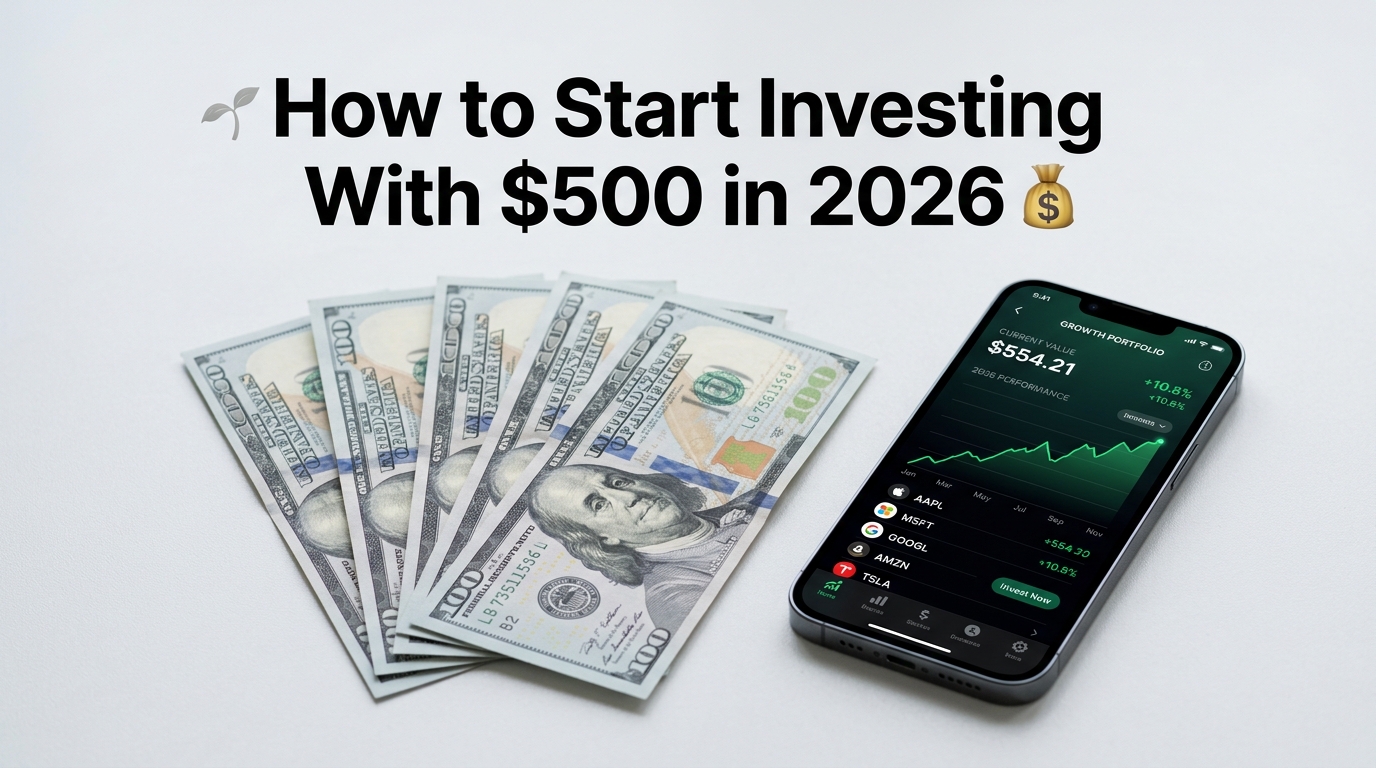
A lot of people think investing starts only when you have a big lump sum, but that is one of the most expensive myths in personal finance. If you have $500, you already have enough to begin building a real investing habit, and in 2026, low-cost platforms make it easier than ever to get started.
Contents
- 1 Introduction
- 2 First, make sure the money is ready
- 3 Choose the right account
- 4 Good places to start
- 5 Keep it simple with one or two investments
- 6 Why simple works
- 7 A sample $500 investment plan
- 8 Option 1: Growth-focused
- 9 Option 2: Balanced
- 10 Option 3: Hands-off
- 11 Use fractional shares if needed
- 12 Automate future contributions
- 13 Avoid common beginner mistakes
- 14 Mistakes to avoid
- 15 How to think about risk
- 16 What to do next
- 17 Final thoughts
Introduction
The hardest part of investing is usually not the money itself; it is getting past the “I should probably wait until I have more” mindset. That delay often lasts for years, and meanwhile the money just sits there doing nothing. This guide shows you how to start investing with $500 in 2026 in a practical, beginner-friendly way, without turning the process into a side quest.
First, make sure the money is ready
Before you invest a single dollar, check whether that $500 is actually safe to invest. If you might need it for rent, a car repair, or an emergency next month, it should probably stay in cash for now.
A good rule is:
-
Keep an emergency fund first, even if it is small.
-
Pay off very high-interest debt before investing.
-
Invest only money you can leave alone for a while.
That order matters because investing works best when the money has time to grow and you are not forced to sell at the worst possible moment.
Choose the right account
The account you use matters almost as much as what you buy. For most beginners, a low-cost brokerage account is the easiest place to start. If you have access to a retirement account like a Roth IRA and qualify for it, that may be even better for long-term goals because of the tax advantages.
Good places to start
-
Brokerage account for flexibility.
-
Roth IRA or similar retirement account for long-term tax benefits.
-
Robo-advisor if you want a hands-off approach.
-
Employer retirement plan if you already have access to one.
If you are investing for the long haul, the tax benefits of retirement accounts can make a real difference over time. If you want more flexibility, a regular brokerage account keeps things simple.
Keep it simple with one or two investments
With only $500, the biggest mistake is trying to create a complicated portfolio with too many moving parts. You do not need ten stocks, three sectors, and a spreadsheet that looks like a hedge fund forgot to log out.
A simple beginner portfolio usually works better:
-
One broad market ETF.
-
One total bond fund if you want more stability.
-
Or one diversified target-date fund if you want a true set-it-and-forget-it option.
Why simple works
Broad ETFs give you instant diversification across many companies, which reduces the risk of being too dependent on one stock. Target-date funds do even more of the work for you by automatically adjusting the mix over time.
For many new investors, simple is not a compromise. It is the smartest move.
A sample $500 investment plan
If you want a practical starting point, here is a straightforward example of how to invest $500 in 2026:
Option 1: Growth-focused
-
$400 in a broad U.S. stock ETF.
-
$100 in an international ETF.
This gives you mostly growth exposure with a bit of global diversification.
Option 2: Balanced
-
$300 in a broad U.S. stock ETF.
-
$100 in an international ETF.
-
$100 in a bond ETF or cash reserve.
This option adds a little more stability, which can help if you are nervous about volatility.
Option 3: Hands-off
-
$500 in a target-date fund.
This is the easiest route if you want one fund to do the balancing for you.
One of the best things about investing in 2026 is that many platforms offer fractional shares. That means you do not need enough money to buy a whole share of an expensive fund or stock. You can invest part of a share and still get started immediately.
That is a big deal for beginners because it removes the old barrier of “I can’t afford the full share, so I’ll wait.” Waiting is overrated.
Automate future contributions
The real power of investing is not the first $500. It is the money you keep adding afterward. Once you open the account and invest your first amount, set up automatic contributions from your paycheck or checking account.
Even $25 or $50 a week can turn a small beginning into something much more meaningful over time. Consistency is what builds momentum, not one dramatic deposit followed by three months of forgetting about it.
Avoid common beginner mistakes
A lot of beginners lose progress because they make investing more exciting than it needs to be. The goal is not to win a game of financial fantasy football. The goal is to grow wealth steadily.
Mistakes to avoid
-
Putting the money into random meme stocks.
-
Chasing whatever is trending on social media.
-
Paying high fees for no good reason.
-
Panicking when markets dip.
-
Investing money you may need soon.
If a strategy sounds thrilling but you do not understand it, that is usually a sign to slow down.
How to think about risk
All investing carries risk, even when you are being careful. Stocks can fall, bonds can lose value in certain conditions, and markets can stay volatile longer than you expect. That is normal.
A simple way to manage risk with $500 is to choose diversified funds instead of individual bets. That way, one company’s bad news does not ruin your whole plan. You are aiming for steady progress, not financial fireworks.
What to do next
Once your first $500 is invested, your job becomes much easier: keep going. The next milestone might be $1,000, then $2,500, then $5,000. Small amounts matter more than people think because investing is a habit before it is a balance.
A realistic action plan looks like this:
-
Open the account.
-
Choose one or two simple investments.
-
Invest the $500.
-
Set up automatic contributions.
-
Review once in a while, but do not obsess.
Final thoughts
Learning how to start investing with $500 in 2026 is really about starting before you feel perfectly ready. You do not need a huge salary or a complicated strategy to begin. You need a sensible account, a simple investment choice, and the patience to keep adding over time.